Are you worried about whether the ghee you’re buying is pure or adulterated?
You’re not alone.
According to FSSAI reports, ghee is one of the most commonly adulterated food products in India. Adulterants like vanaspati, vegetable oils, animal fat, and even synthetic chemicals are mixed to increase profits.
The problem? Adulterated ghee not only cheats you of nutrition but can seriously harm your health.
The good news? You don’t need a laboratory to check ghee purity. With these 9 simple tests, you can identify pure ghee right in your kitchen.
As a ghee manufacturer with over a decade of experience, we at VersatileFM test every batch rigorously. Today, we’re sharing the exact methods that work.
Read the full methods to identify pure ghee vs adultered ghee:
Why Ghee Purity Matters More Than You Think
Before diving into the tests, let’s understand why this matters:
Health Risks of Adulterated Ghee:
Vanaspati contains trans fats linked to heart disease
Mineral oils can damage liver and kidneys
Synthetic colors may cause allergic reactions
Rancid fats lead to digestive problems
Long-term consumption causes chronic health issues
Financial Loss:
You pay premium prices for inferior products
Reduced nutritional value means wasted money
Commercial buyers face customer complaints and returns
For Sweet Shops and Restaurants:
Adulterated ghee affects taste of sweets
Inconsistent quality impacts business reputation
Health inspections can result in penalties
9 Simple Tests to Identify Pure Ghee at Home
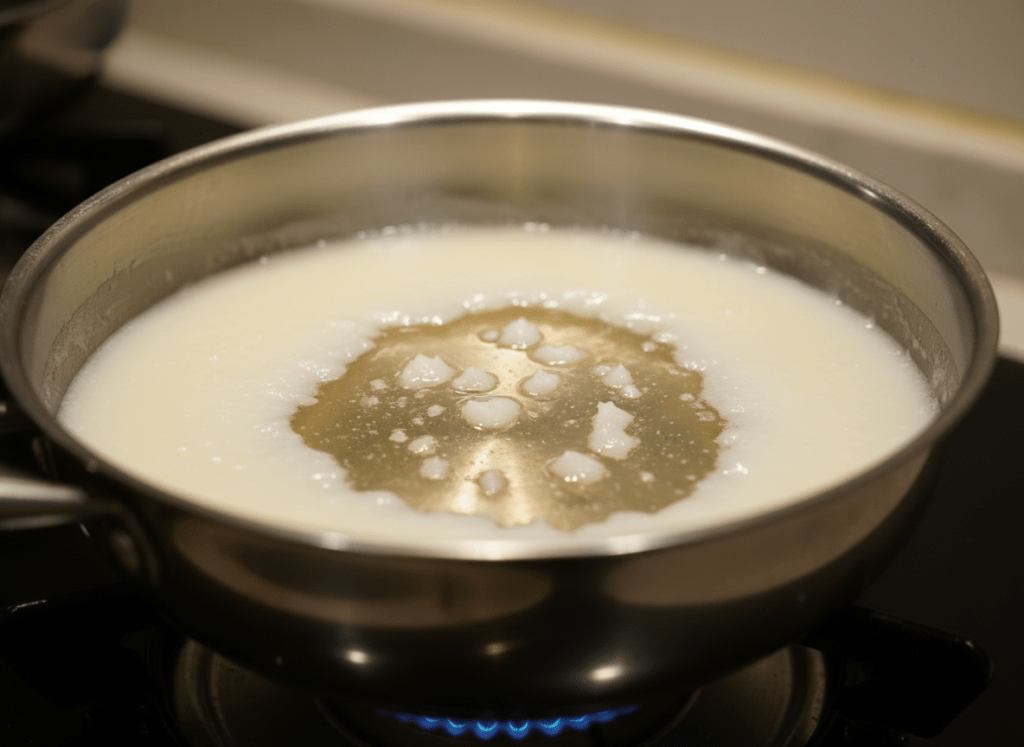
Test 1: The Heat Test (Most Reliable)
What You Need: Small pan, 1 teaspoon ghee, low flame
How to Perform:
Take a clean, dry pan
Add one teaspoon of ghee
Heat on low flame
Observe carefully
Results:
Observation
Meaning
Melts immediately (within 30 seconds)
Pure ghee
Turns dark golden-brown quickly
Pure ghee
Pleasant, nutty aroma releases
Pure ghee
Takes longer to melt
Likely adulterated
Turns very dark or black
Contains impurities
No aroma or artificial smell
Adulterated
Why This Works:
Pure ghee has a low melting point (32-35°C) and specific combustion properties. Adulterants change these characteristics noticeably.
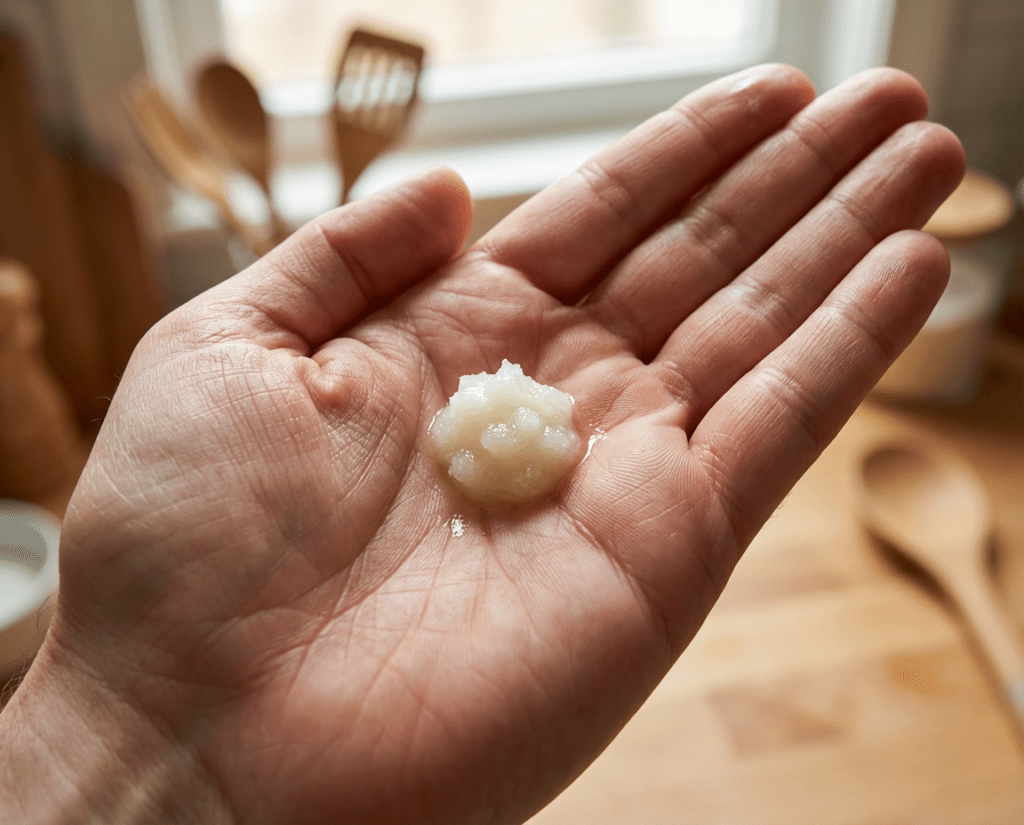
Test 2: The Palm Test
What You Need: Clean palm, small amount of ghee
How to identify pure ghee:
Take a small amount of ghee (pea-sized)
Place on your palm
Wait and observe
Results:
Pure Ghee: Melts completely within 30-60 seconds from body heat alone
Adulterated Ghee: Takes longer to melt or doesn’t melt fully
Why This Works to identify pure ghee:
Pure ghee melts at body temperature. Adulterants like vanaspati and vegetable fats have different melting points.
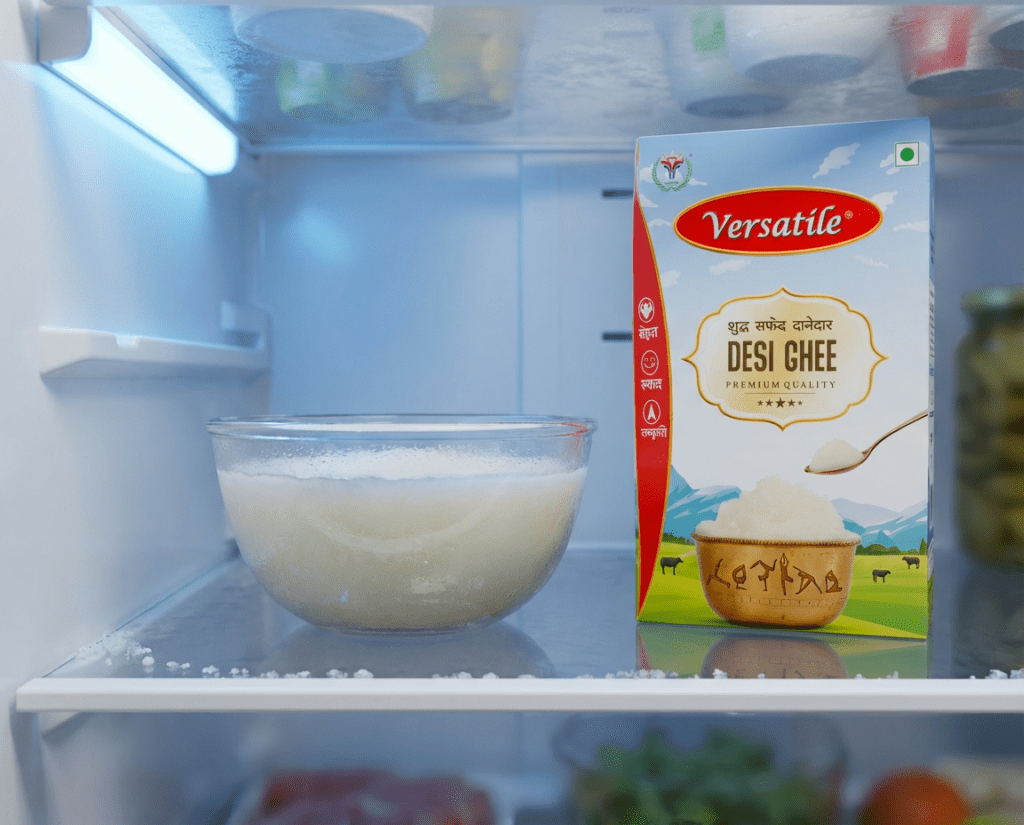
Test 3: The Bottle Test (Refrigerator Test)
What You Need: Glass bottle or jar, ghee sample, refrigerator
How to identify pure ghee:
Melt the ghee completely
Pour into a clean glass bottle
Place in refrigerator for 30-40 minutes
Remove and observe
Results to identify pure ghee:
Pure Ghee: Solidifies uniformly with consistent texture throughout
Adulterated Ghee: Separates into distinct layers (oils float on top)
Why This Works:
Different fats have different solidification points. When mixed fats cool, they separate into layers based on their properties.
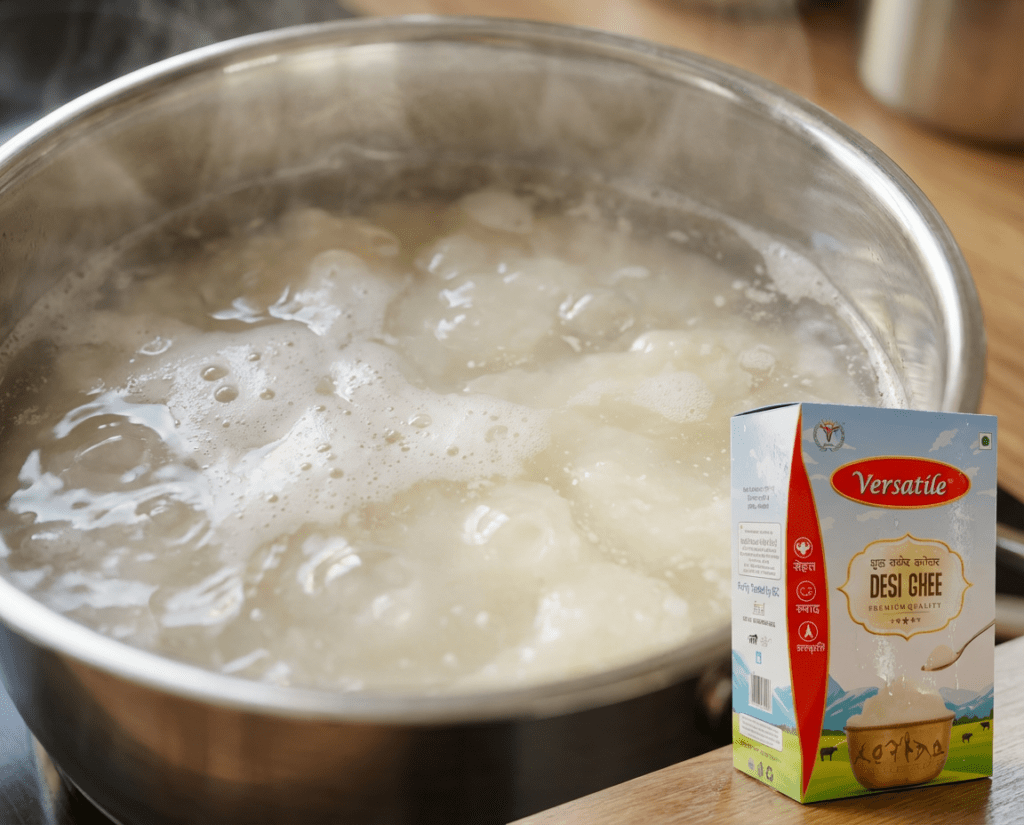
What You Need to identify pure ghee: Two vessels (one smaller fitting inside larger), water, ghee
How to Perform:
Fill larger vessel with water
Place smaller vessel inside with ghee sample
Heat water until boiling
Let ghee melt completely
Remove and let cool naturally
Observe solidification pattern
Results:
Pure Ghee: Solidifies from bottom upward uniformly
Adulterated Ghee: Uneven solidification, different textures in different areas
Test 5: The Iodine Test
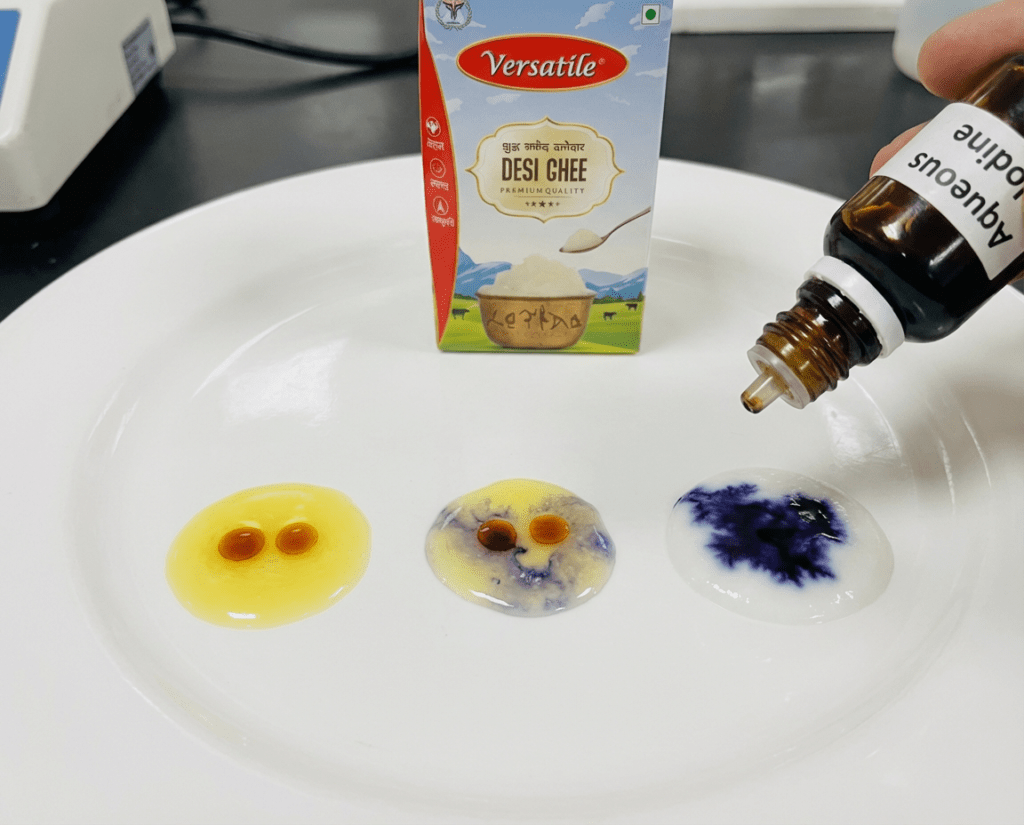
What You Need: Iodine solution (available at pharmacies), ghee sample, white plate
How to Perform:
Take small amount of melted ghee on white plate
Add 2-3 drops of iodine solution
Observe color change
Results:
Pure Ghee: No color change (iodine remains brown/orange)
Adulterated with Starch/Mashed Potatoes: Turns blue/purple
Why This Works:
Iodine reacts with starch to produce blue color. Starch is sometimes added as a cheap filler to increase volume.
Test 6: The Sugar Test (Baudouin Test)
What You Need: Concentrated hydrochloric acid, sugar, test tube (for careful testing)
How to Perform to identify pure ghee:
Take 5ml melted ghee in test tube
Add equal amount of concentrated HCl
Add pinch of sugar
Shake well
Let it settle
Results:
Pure Ghee: No color change in acid layer
Adulterated with Vanaspati: Red/crimson color in acid layer
Safety Warning: This test involves dangerous chemicals. Perform with extreme caution or skip for simpler tests.
Test 7: The Smell Test
What You Need: Your nose, ghee sample
How to Perform:
Open the ghee container
Smell directly
Also smell while heating
Results:
Smell Type
Indication
Rich, pleasant, buttery aroma
Pure ghee
Slightly nutty when heated
Pure ghee
Artificial or chemical smell
Adulterated
Rancid or sour smell
Old or poorly stored
No smell at all
Likely refined/processed adulterant
Test 8: The Texture Test
What You Need to identify pure ghee: Your fingers, ghee sample
How to Perform:
Take ghee between fingers
Rub gently
Observe texture and feel
Results:
Pure Ghee: Grainy texture with small granules, smooth when rubbed
Adulterated Ghee: Overly smooth, sticky, or waxy feel
Additional Check:
Pure ghee at room temperature should be semi-solid with visible granular structure. If it’s completely smooth like cream, it may contain additives.
Test 9: The Water Test
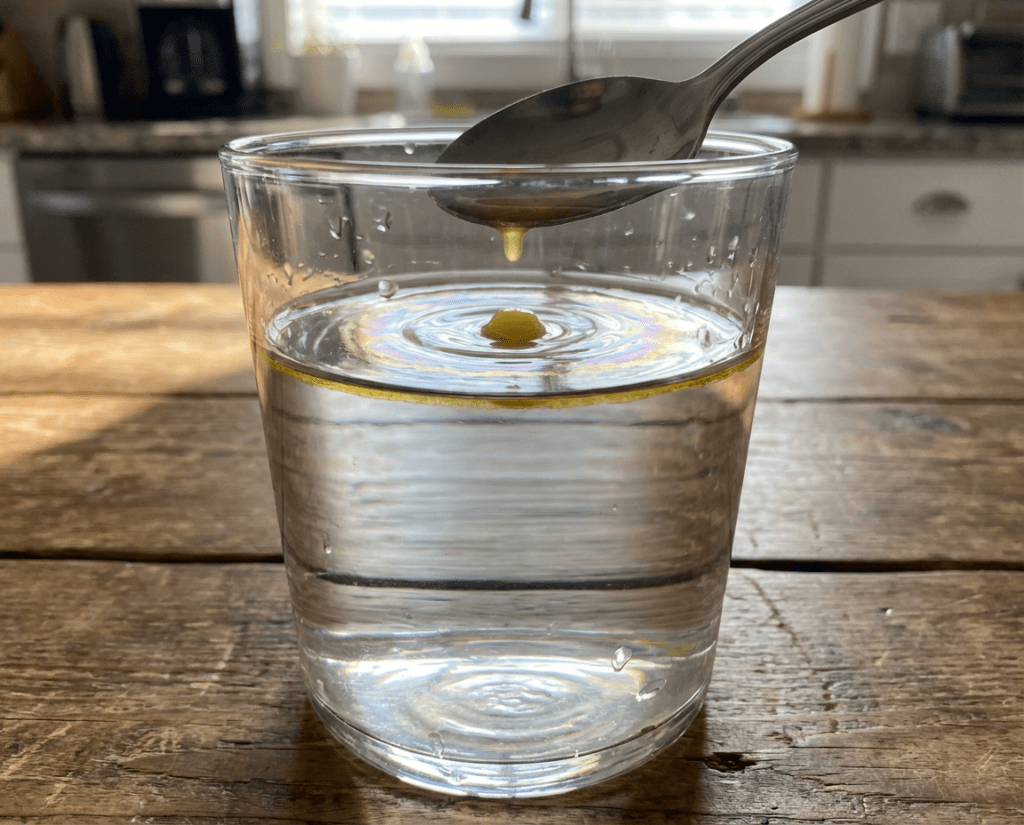
What You Need to identify pure ghee: Glass of water at room temperature, ghee sample
How to Perform:
Take a glass of water at room temperature
Drop small amount of ghee into water
Observe behavior
Results:
Pure Ghee: Floats on top, doesn’t mix with water easily
Adulterated Ghee: May dissolve partially or sink
Quick Comparison Chart: Identify Pure Ghee vs Adulterated Ghee
Parameter
Pure Ghee
Adulterated Ghee
Color
Golden yellow
Very pale or very dark
Smell
Rich, pleasant, nutty
Artificial, chemical, or none
Texture
Granular, slightly grainy
Overly smooth or waxy
Melting
Quick, uniform
Slow, uneven
Taste
Sweet, rich, buttery
Bitter, sour, or tasteless
Refrigeration
Solidifies uniformly
Forms layers
Heat Response
Golden brown, aromatic
Dark, no aroma
Price
Market appropriate
Unusually cheap
Signs of Adulterated Ghee to Watch For
Red Flags When Buying:
Unusually Low Price: If it’s significantly cheaper than market rate, question it
No FSSAI License: Always check for valid FSSAI number on packaging
Unclear Labeling: Missing manufacturing date, batch number, or ingredients
Uniform Appearance: Real ghee has natural variations in granular structure
If you’re buying ghee for your sweet shop, restaurant, hotel, or food manufacturing business, here’s how to protect your business:
Before Placing Order:
Request Lab Reports: Ask for recent third-party lab analysis
Check FSSAI License: Verify the manufacturer’s FSSAI registration
Visit Facility: If buying large quantities, visit the manufacturing unit
Ask for Samples: Test samples before committing to bulk orders
Check Reviews: Look for testimonials from other commercial buyers
During Receiving:
Batch Verification: Match batch numbers with provided documents
Visual Inspection: Check packaging integrity and labeling
Random Testing: Perform 2-3 simple tests on each batch
Temperature Check: Ensure proper cold chain was maintained
Ongoing Quality Control:
Consistent Supplier: Work with reliable manufacturers
Regular Testing: Periodic lab tests for high-volume purchases
Document Everything: Keep records for FSSAI compliance
VersatileFM’s Quality Promise
At Versatile Foods & Marketing, we understand that trust is earned through consistent quality.
Our Quality Measures:
100% Pure Buffalo Ghee: No mixing, no shortcuts
FSSAI Licensed Manufacturing: Compliant with all food safety standards
Lab Testing Every Batch: Third-party verification available
Transparent Process: Factory visits welcome for bulk buyers
Consistent Supply: Reliable quality across all orders
Got Questions? We’ve Got Answers!
How can I test ghee purity without any equipment?
The easiest equipment-free tests are the Palm Test (ghee melts on the palm within 30-60 seconds) and the Smell Test (rich, pleasant aroma). These require only your senses and give immediate results.
What should be the color of pure buffalo ghee?
Pure buffalo ghee typically has a rich golden-yellow color. It’s slightly darker than cow ghee due to higher carotene content. A very pale or excessively bright yellow color may indicate adulteration or added colors.
Can ghee be adulterated with cooking oil?
Yes, this is one of the most common forms of adulteration. Vegetable oils like soybean oil, palm oil, and sunflower oil are mixed to reduce costs. The Bottle Test (refrigerator test) easily reveals oil-based adulteration as layers form when cooled.
What is the FSSAI standard for pure ghee?
According to FSSAI, pure ghee must contain at least 99.5% milk fat, at most 0.5% moisture, and at most 0.3% free fatty acids. It should have no added preservatives, colors, or foreign fats.
How long does pure ghee last?
Properly stored pure ghee lasts 12-18 months at room temperature. It should be kept in airtight containers away from direct sunlight and moisture. Refrigeration can extend shelf life further.
Is granular texture in ghee a sign of purity?
Yes, a grainy or granular texture is a characteristic of pure, traditionally made ghee. The granules form during the cooling process after ghee is made. Overly smooth ghee may indicate processing additives.
Conclusion
Identifying pure ghee doesn’t require a chemistry degree or expensive equipment. With these 9 simple tests, you can protect your health and money from adulteration.
Key Takeaways:
Always perform at least 2-3 tests for reliable results
Trust established manufacturers with proper FSSAI licensing
For commercial purposes, insist on lab reports and batch documentation
When in doubt, the Heat Test and Bottle Test are most reliable
Remember, pure ghee is an investment in health. Don’t compromise quality for small savings.
Need Pure Buffalo Ghee for Your Business?
VersatileFM supplies FSSAI-certified pure buffalo ghee to sweet shops, restaurants, and food businesses across India.



 Safety Warning: This test involves dangerous chemicals. Perform with extreme caution or skip for simpler tests.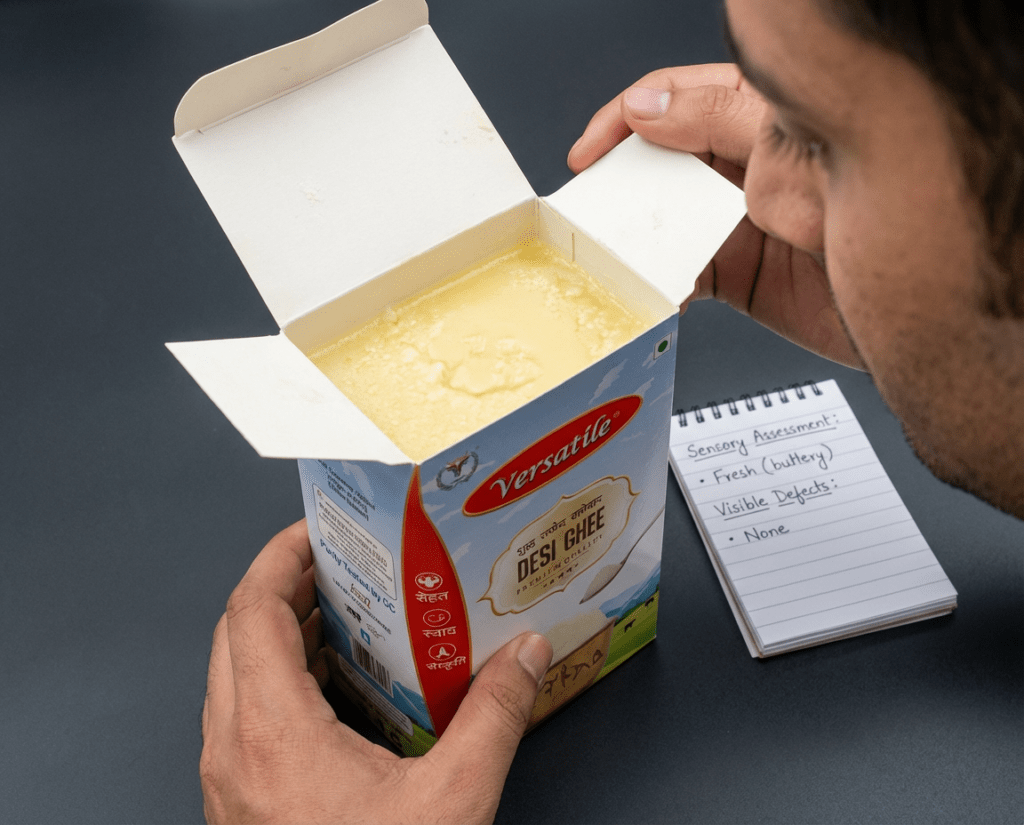
 Call: +91-9599002984
 Email: sales@versatilefm.com